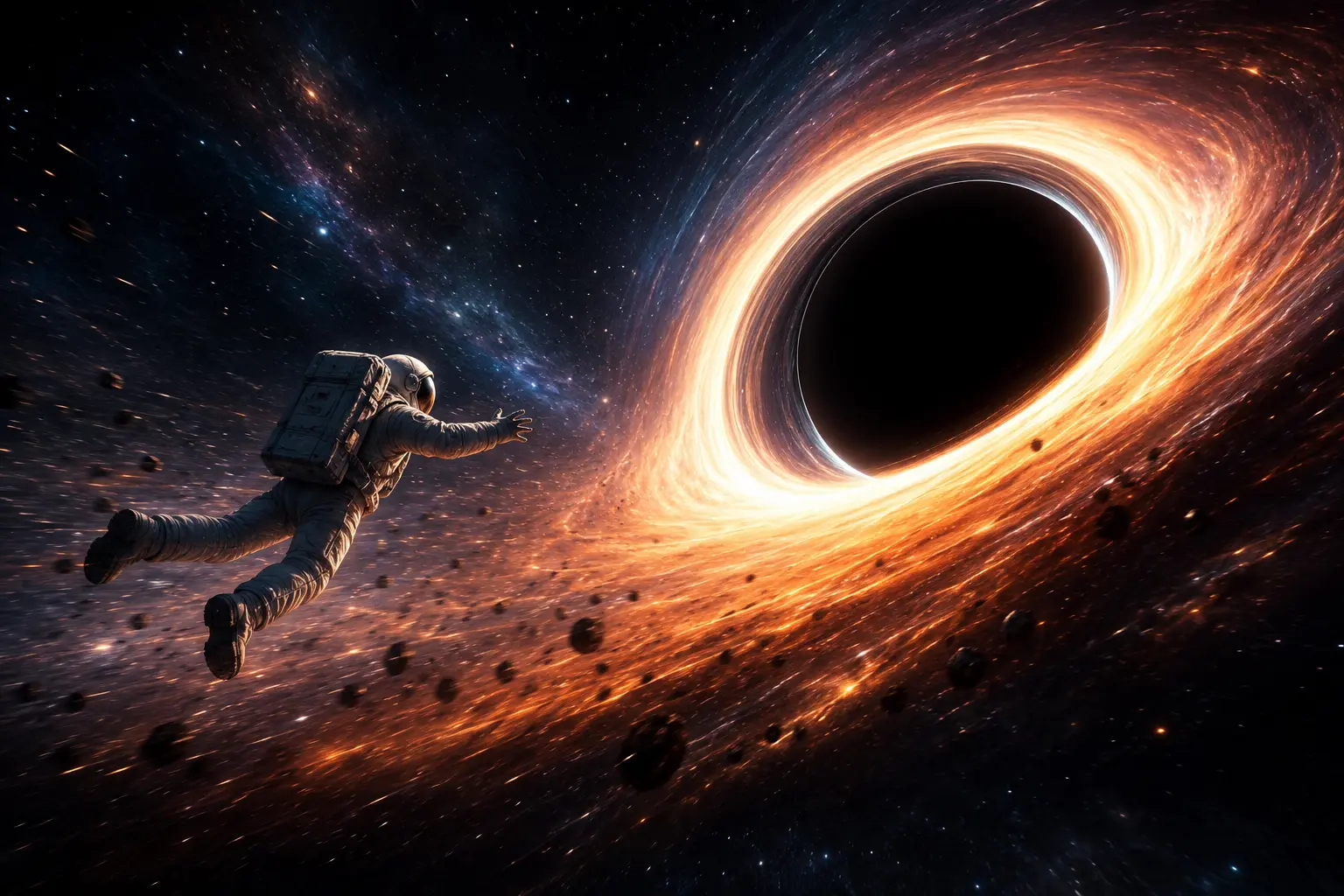
What Really Happens When You Fall into a Black Hole?
Black holes are among the most mysterious and extreme objects in the universe. They are regions of space where gravity becomes so strong that nothing—not even light—can escape once it crosses a boundary called the event horizon. But what would actually happen if a person or spacecraft fell into one?
The answer depends on the type of black hole, your distance from it, and, most importantly, the laws of Einstein’s general relativity. Far from being a simple cosmic vacuum cleaner, a black hole produces some of the strangest effects predicted by modern physics.
What Is a Black Hole?
A black hole forms when a large amount of matter becomes compressed into an extremely small region of space. Its gravity becomes powerful enough that the escape velocity exceeds the speed of light.
At the center of the classical black hole model is a singularity, a region where our current theories predict that matter is compressed to an extreme state and spacetime curvature becomes enormous. However, physicists do not yet have a complete theory of quantum gravity, so we do not know what truly happens at the singularity.
Surrounding the black hole is the event horizon. This is not a physical surface. Instead, it is a boundary in spacetime beyond which escaping to the outside universe becomes impossible.
Step 1: You Would Notice the Gravity Long Before the Event Horizon
A common misconception is that a black hole suddenly becomes dangerous when you cross the event horizon. In reality, the gravitational effects depend strongly on how close you are to the black hole.
As you approach, the difference in gravitational force between your head and feet can become enormous. This difference is known as a tidal force.
Imagine your feet are slightly closer to the black hole than your head. Your feet experience a stronger gravitational pull than your head. As you get closer, this difference can become so extreme that your body would be stretched lengthwise while being compressed sideways.
This dramatic process is commonly called spaghettification.
Step 2: Spaghettification Could Tear You Apart
Spaghettification is one of the most famous consequences of falling toward a black hole.
The effect occurs because gravity changes rapidly with distance. The closer part of your body is pulled much more strongly than the farther part. Eventually, the tidal forces can overcome the structural forces holding your body together.
For a relatively small stellar-mass black hole, these tidal forces could become fatal before you reach the event horizon.
But there is an important twist.
Supermassive Black Holes Are Different
A supermassive black hole can contain millions or even billions of times the mass of the Sun. Because its event horizon is much larger, the gravitational gradient near the horizon can actually be weaker than that of a smaller black hole.
That means, theoretically, you could cross the event horizon of a sufficiently large supermassive black hole without immediately noticing anything unusual.
The real danger would come later, as you continued falling inward.
Step 3: You Would Cross the Event Horizon
The event horizon is often described as the "point of no return."
Once you cross it, there is no possible path back to the outside universe. Even a beam of light directed outward cannot escape.
However, if you were falling freely into a sufficiently massive black hole, you might not see a physical boundary at the moment you cross the horizon.
According to general relativity, your local experience could initially seem completely normal. There would be no solid wall or cosmic barrier waiting at the event horizon.
The important change is causal: after crossing the horizon, all possible future paths lead deeper into the black hole.
What Would an Outside Observer See?
Here is where things become especially strange.
An observer watching you from far away would see your signals becoming increasingly delayed and redshifted as you approached the event horizon. Your clock would appear to run progressively slower compared with theirs.
Your image would become dimmer and increasingly redshifted, eventually becoming effectively impossible to observe.
From the distant observer's perspective, it can appear as though you never quite cross the horizon.
But from your own perspective, you cross the event horizon in a finite amount of proper time.
This difference is one of the fascinating consequences of Einstein's theory of relativity.
Step 4: Time Behaves Strangely
Near a black hole, gravity affects the passage of time.
This phenomenon is called gravitational time dilation. A clock closer to a strong gravitational field runs more slowly relative to a clock farther away, as measured by distant observers.
If you could somehow hover near the event horizon while maintaining a safe distance, someone far away could see your clock running extremely slowly.
Meanwhile, your own clock would continue ticking normally from your local point of view.
This doesn't mean that you personally feel time "slowing down." Relativity is about how measurements of time compare between different observers following different paths through spacetime.
Step 5: Light Around the Black Hole Becomes Distorted
Black holes do not simply pull objects inward. Their gravity also bends the path of light.
This effect is known as gravitational lensing.
As you approach a black hole, light from distant stars and galaxies could appear distorted, magnified, or wrapped around the black hole. In some circumstances, you could see multiple distorted images of objects that are actually located behind the black hole.
The region around the black hole could therefore look extremely strange, with the background universe appearing warped into arcs and rings.
The Black Hole's Shadow
A black hole itself does not emit visible light in the conventional sense, but the region around it can glow brightly if it is surrounded by hot gas.
The black hole shadow is the dark-looking region produced by the capture and strong bending of light around the black hole.
This is what made the famous black hole images so remarkable: astronomers were able to observe the shadow against the glowing material surrounding the black hole.
Step 6: Eventually, the Singularity Awaits
If you continue falling inward according to the classical description of a non-rotating black hole, you eventually reach the singularity.
But this is where our understanding becomes incomplete.
General relativity predicts that spacetime curvature becomes extreme at the singularity. However, physicists expect that quantum effects should become important under such extreme conditions.
We currently do not have a complete, experimentally confirmed theory that combines quantum mechanics and gravity well enough to describe the ultimate interior of a black hole.
So we cannot honestly say that we know exactly what happens at the singularity.
Does a Black Hole Destroy Everything Immediately?
Not necessarily.
A black hole is not a cosmic vacuum cleaner that automatically sucks in everything around it. If the Sun were somehow replaced by a black hole with exactly the same mass, Earth would continue orbiting at approximately the same distance because the gravitational influence at that distance would be essentially the same.
The major difference would be that there would be no sunlight.
Black holes become especially dangerous when an object gets sufficiently close to them.
The Physics Behind the Mystery
Black holes provide a natural laboratory for studying some of the deepest ideas in physics:
- General relativity explains how mass and energy curve spacetime.
- Gravitational time dilation shows how gravity affects measurements of time.
- Gravitational lensing demonstrates how massive objects bend light.
- Tidal forces explain spaghettification.
- Quantum physics raises questions about what happens to information and matter inside black holes.
- Hawking radiation suggests that black holes may slowly lose energy through quantum effects.
These ideas connect gravity, spacetime, thermodynamics, and quantum mechanics in ways that physicists are still trying to fully understand.
So, What Would Really Happen If You Fell Into a Black Hole?
The experience would depend on the black hole's mass and structure.
Near a smaller black hole, intense tidal forces could stretch and destroy you before you reached the event horizon. Near a sufficiently massive supermassive black hole, you might cross the event horizon without immediately noticing anything dramatic.
After crossing it, however, escape would become impossible. You would continue falling toward the interior, while an outside observer would receive increasingly delayed and redshifted information about you.
Eventually, according to classical general relativity, you would encounter the singularity—but what truly happens there remains one of the biggest unanswered questions in modern physics.
Final Thought
Black holes remind us that the universe is far stranger than everyday experience suggests. They challenge our understanding of space, time, gravity, information, and even the limits of physics itself.
The next time you look at a star-filled night sky, remember: somewhere in the universe, there may be a black hole bending light, slowing time, and warping spacetime in ways that would seem almost impossible—yet are predicted by the laws of physics.
Explore more fascinating physics topics and science learning resources with CT Physics.


